Sunday, September 28, 2008

Splash Around

Artist's Statement

The concept for my poster assignment is a public announcement to promote healthy living. My goal is to encourage families to spend summer outside, being active and energetic. The targeted audience for my ad is children, teenagers and adults. Although the ad aims to show swimming as a summer activity, the message from the ad is to just spend time outdoors.
The program I used to create this poster was Adobe Photoshop CS. I anticipated some challenges with this project, such as getting my creative spark. I found that it took me much longer to think of an idea than it did to actually make the poster. Certain obstacles that occurred with the Photoshop program were creating a textured type as well as creating a choppy flow throughout the ad. I had originally planned to place pictures inside a different script, but the ad seemed to busy once I managed to accomplish this. I found that I wanted to place a filter on the text but I did not know you had to rationalize the text first. After playing around with settings of the program I learned of how to emboss the text. Flow throughout the ad was also another obstacle. I had to edit and erase many different parts of the original picture and in doing so I created a very blocky poster. I dealt with this issue by letting the background be a gradient of the same colour blue as the water. The illusion is now that the water goes on and on instead stopping and meeting the sky.
From this project I learned that everything comes with playing around with ideas. The original idea I had for this poster seems like an entirely different thought from this final project. Playing with the program settings was the way I learned how to deal with problems and technological stubbornness. Different sparks of creative flair would arise as I would learn something new about the program’s tools so I would morph my project to adapt to the new idea.
I do believe this ad successfully hits the target audience. No matter one’s age, race or gender, anyone can swim. The poster features a vast difference of people all seeming to love being in the water. The positive picture of people loving the water creates a feeling of wanting their happiness for oneself, which also re-enforces the message of spending time outdoors.

Typography

I have always had an obsession with drawing different kinds of letters. I used to be able to sit through an entire math class and fill paper after paper just doodling each peer’s name. When I was younger, my mom would write our names in big block letters and we would colour them with different patterns and shapes. So, this week when we had a lecture on typography I felt a little closer to home.


Lipstick Jungle

The font used for NBC’s Lipstick Jungle is very effective for soliciting their show. The letters seem to be very elegant. The length of the L, P, K, J and G also highlight the stereotypical model-like look: women, tall and petit. The letters that hang can also be associated with the word ‘jungle’ because of hanging vines. The round shape to each letter is bold but warm. The letters are chic and appear stylish on the poster. The typography used is definitely efficient because it is appealing to women in high fashion.


Impossible Is Nothing

The letters used in this advertisement for Adidas make a bold statement. The all-capital letters show force and drive. The message written from Adidas about the word ‘impossible’ is delivered strongly in the white writing clustered together in the center of the page. This ad targets every sports enthusiast. The ad also aims to motivate people to surpass the known. The inspirational message keeps the readers attention because of the easy- to- read lettering.


Superspeed Tunnel

The letters in Disneyland’s Tomorrowland advertisement draw the reader into the poster. The way the letters are leading back into the frame, the lines that are pushed from the top and the slant and angle of the words emphasize what the ad is for. The lettering suits the advertisement because the words themselves show motion and speed. The ride showcased is called “Peoplemover” and the word itself creates the illusion of moving across the page.

Monday, September 22, 2008

A New Colour

The Depth Of Crayons

Red, blue and yellow are the primary colours.  The magic of these three can mix and combine together to create every colour of the rainbow, every colour imaginable, every Crayola crayon.  This week during Digital Media Production a lesson on colour was the topic of discussion.

In grade three I remember learning about the colour wheel.  And, now, eleven years later, not only am I learning about a circle of colour, but also I am learning about how to make the colours.  Through different saturations, tints and shades, colours are produced and explored.  With the use of technology, colours can be expanded and adapted to every object.  The colour systems for computers and digital media are RGB (red, green and blue) as well as CMYK (cyan, magenta, yellow and black).  These colours are able to range from values of light and dark between 0-256, which means that with a combination of three or four colours the shades of pinks and purples and blues and oranges and greens are endless. 

Without colours our world would be bland and dark.  Certain colours are also associated with symbolism - red with love, blue with sadness, green with greed, purple with royalty.  These colours help give depth and feeling to life.  Colours animate and energize the world around us.  The more colours that are created through digital art draw the eye into the picture.  Even in black and white, a captivating photo of hues allows the mind to wander through the image. 

Picking out clothes, the changing of streetlights and eating a meal all incorporate colours into common life.  Created from adding whites (tints) and blacks (shades) into the original primary colours, colours can be mixed and matched into contrasting and clashing settings.  Within that box of crayons are a million possibilities.   

Monday, September 15, 2008

CRAP Principles

CRAP Media
This week during my Media Production class I learned all about the CRAP Principles, first introduced by Robin Williams. The CRAP Principles are used for design; they are to help one’s website, poster, advertisement, song, (etc.), stay organized, easy to process, eye-catching and sharp. The CRAP acronym represents Contrast, Repetition, Alignment, and Proximity. This ideology is displayed in the following photographs.


Walt Disney Pictures: Enchanted <http://www.aolcdn.com/moviefeatures/enchanted-poster-433>
The Enchanted movie poster from Walt Disney Pictures demonstrates every CRAP Principle.

Contrast: Contrast is shown through colour and font. The top of the poster and the bottom reflect opposites of one another. The complimentary colours and differing feelings of dark and light and fierce and welcoming help show contrast. The curved style of the title stands almost 3D where as the tagline is spread straight across the top of the ad. The different sizes of the name and slogan demonstrate contrast.


Repetition: The colour gold that is used for the title is also used for the tagline. The font for the name and slogan are also the same. The buildings that line the left- hand side of the poster are paralleled on the right-hand side. The glowing aura behind the moon is also repeated around the characters.


Alignment: The arrangement of the credits is built as a pyramid at the bottom of the poster. This alignment is creative, interesting and works well for the child targeted ad.
Proximity: The Disney designer seems to have grouped not only colours and words together, but also characters. Without even having seen the movie one would know that the woman at the top of the page to be the “bad guy” and the characters at the bottom to be the heroes. This use of proximity helps to explain what the movie is about.


Revolution Studios: Across The Universe <http://www.postergeek.com/albums/userpics/poster_across-the-universe.jpg>
The movie poster for Across The Universe demonstrates the CRAP principle of contrast. Stars of a white shade illuminate the dark blue night sky. The small size of font for the tagline allows the title to jump off the page. Repetition is shown through the melted blue sky and again in the strawberry. The idea of a solid colour fading is shown in the background of the sky (blues) and in the forefront strawberry (red).


AT&T Advertisement (In-Touch Magazine)


This advertisement demonstrates Proximity, Repetition and Alignment. The words are all grouped together and aligned in the top right hand corner. The colour orange of the words is not only is contrasted with the black background, but is also repeated from the bottom of the AT&T logo. The thick, round-edged box highlighting the AT&T logo is also used to advertise the Goo Goo Dolls newest track. The black and white photograph of the band is also repeated of the white guitar and black background. The words are also aligned to the top right corner. This creates an easier, quick read.


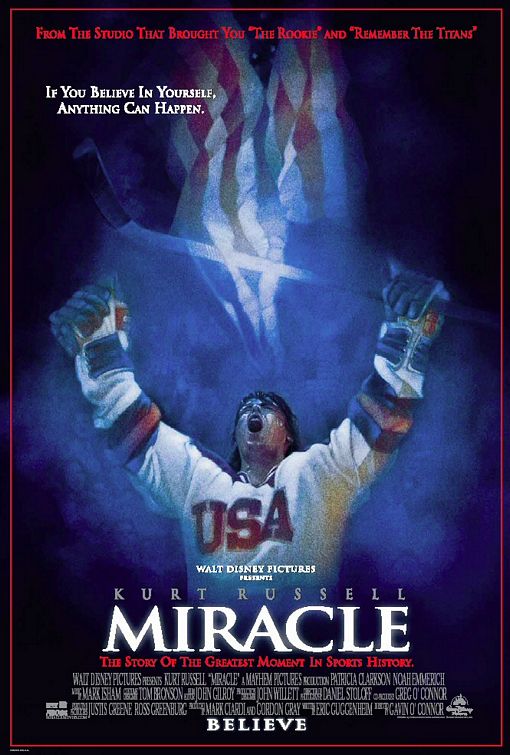
Walt Disney Pictures: Miracle <http://www.impawards.com/2004/posters/miracle.jpg>


The Miracle movie poster displays contrast in colours. The red, blue and white not only contrast one another but also represent the United States. The highlighted title of Miracle is repeated with the illuminated hockey stick and flag. The same font is also used for the tagline and title. The diverse sizes of fonts are aligned down the bottom of the center of the poster. These ranges of sizes help to the reader see the important details promptly. Proximity is arranged by having all the objects grouped down the middle of the poster.


These movie posters and advertisements demonstrate all the CRAP Principles I have learned throughout the course so far. Now, after analyzing each advertisement it’s my turn to apply the CRAP Principles when I create my own poster.

Tuesday, September 2, 2008

Is The World A Digital Domain?

Learning About A Digital Era.

Yesterday, the first day of my newfound career at Ryerson University, began with an uncertainty as to the term "digital media".  The thought of television, computers and movies crossed my mind.  Animated films, commercials, and other visual graphics that move and change seemed to reel over and over the idiom "digital media".  The bubble of gadgets and entertainment was erupted when a boy from a few rows back explained the phrase "digital media" meant using coded numbers zero and one.  
Digital media seems to provide a great source of amusement to the world.  The growth of these digits expanding and providing has seemed to help forward our technological age.  As opposed to analog, the original "second-hand" clock, digital has always appeared to be easy and more-advanced.  My impression of "digital media" has expanded beyond the ordinary thought of cell phones and CDs, but to a world of wonder and marvel to learn about this digital working.  How many ways can an infinite number of zeros and ones be arranged?  And how do these numbers become processed into digital art? 

Upon graduating and attaining the ability to produce digital forms of communication and leisure activity, the thought of the "behind- the - scenes" look at how digital media comes together seems only crucial.  As a student of the Radio and Television industry, the digital media study and examining could potentially help further the knowledge for a student to better be able to influence the masses of whom one would be entertaining and informing.